

Once upon a time, in a small village far far away in Finland, a woman named Inga Åbacka lovingly handcrafted hundreds of elves (jultomtar in Swedish) out of clay using only a spoon and her hands. These cheerful and colorful Christmas elves scattered around the region and found new homes. Inga sold these elves and donated the money to the church. Over the years my grandmother, Gunhild, bought elf after elf, and gave many of them to me and all her grandchildren and friends. After my elves had journeyed with me to the United States I began to understand that they were not regular elves at all, and that is where this story begins…
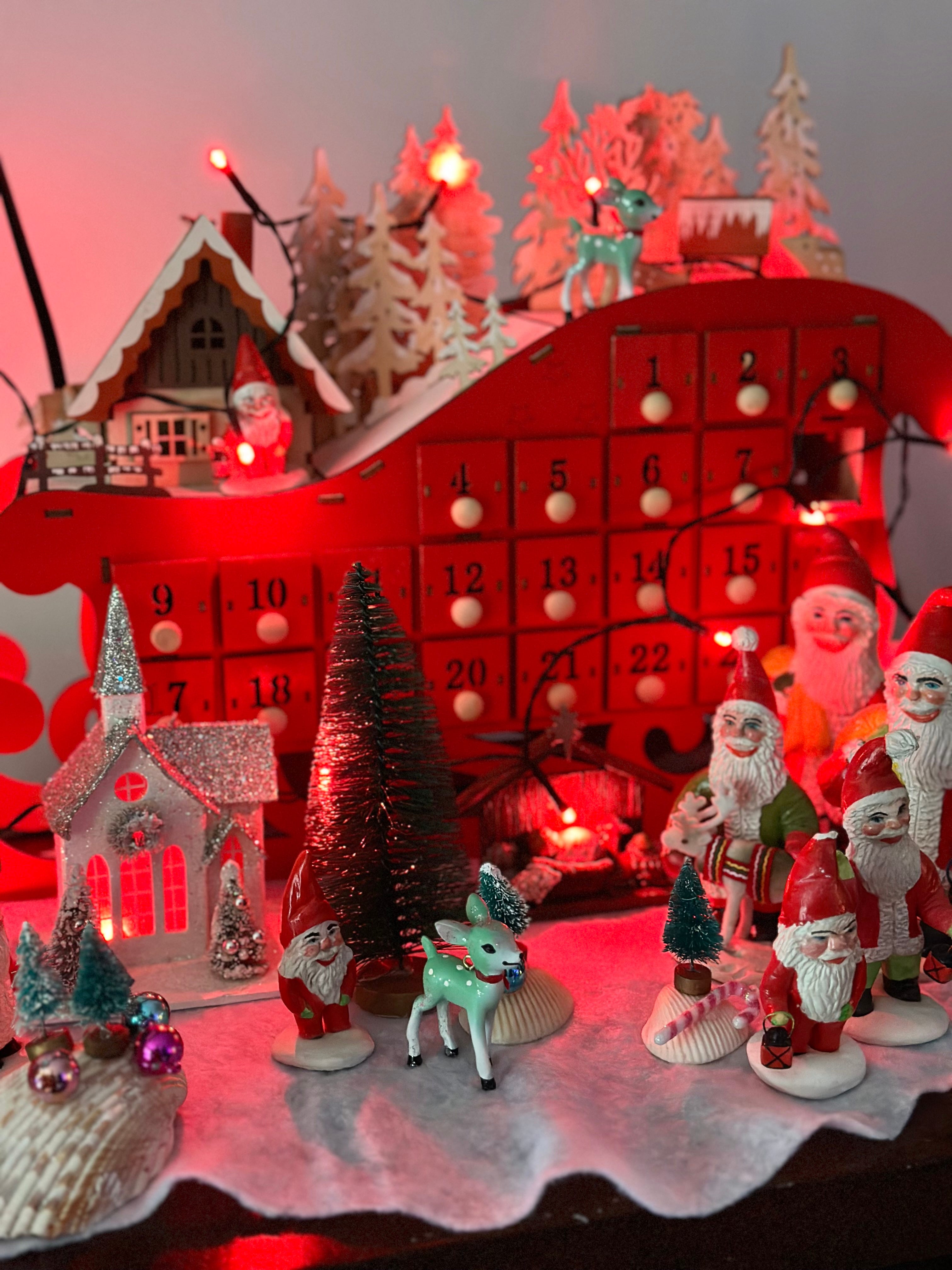
On Saturday, December 13th, 2025, the thirteen elfs (you can technically also call them elves) woke up from their yearly hibernation. Just like some tortoises go to sleep over the cold season, these elves hibernate through the warmer season. The hustle, the bustle, the colorful surroundings, the lights, the sounds, the screaming children and the endless social media stream — it’s a taxing profession to be an elf. But! Now they’re refreshed and rejuvenated and ready for a brand new Christmas season!
Naturally, as we all know, they arrive a few weeks before Julgubben (pronounced “Yule-gubb-en”), Father Christmas, to prepare everything and check that naughty or nice list. This year the elves woke up on Luciadagen, the day of Saint Lucy.
See, the energy required to sustain an elf over the Christmas season, which extends over a period of about a month, requires roughly eleven months of rest. It is pure science. Elf science. So, they crawled out of the shoe box in which they hibernate amidst the red sheets of glittery tissue paper, gathered around on my coffee table and started chatting about this Christmas season.
“Christmas season is hard work, you know,” says Guacamo, the farmer elf. Guacamo fondly talks about his avocado farming days, and I often wonder when he ever had time for avocado farming amidst his passion for salsa dancing, a hobby he and Salsa share. Salsa is a straw better in terms of pure expressiveness when it comes to salsa dancing, and it irks Guacamo to no end. But Guacamo’s reindeer, Gin, is always by his side as consolation.
The Elf troupe’s unelected leader is of course Monty, the thespian extraordinaire. He trod the boards of many a famous theater, but he remorsefully and frequently reminds us of his one eternal regret:
“I will never play the Dane…”
Due to his small stature, Mikro has been able to go on many side quests over the years. He’s been to Arizona several times, and California of course. He sneaks into suitcases around Christmas time and who would have the heart to be angry with such an innocent-looking elf? It’s a miracle in itself that he’s not strayed off on any of the trips, but always returned safely to his brethren.
As with most groups, there’s always the stinker. Whether an actual olfactory offensive kind or just attitude-wise — Prütti is both. He’s tried, oh how he’s tried, but he keeps telling us, in his slightly pitiful voice:
“It’s IBS, I can’t help it! I try telling them I am gluten intolerant, and how hard it is for me to digest food. My allergies always flare up around this time of the year, but no one seems to care! My metabolism has never been the same after I tried one of Guacamo’s avocado diets…”
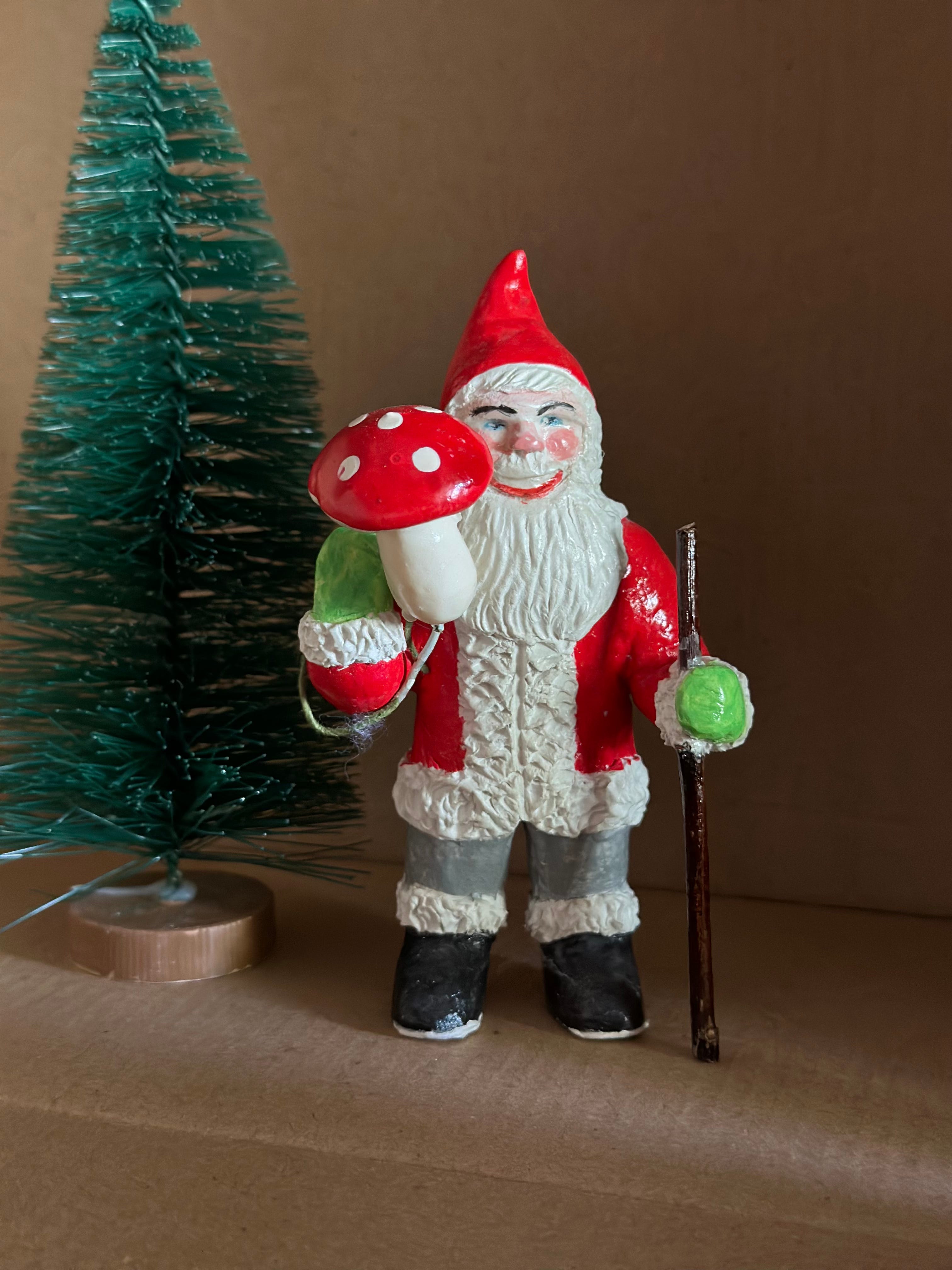
With a gigantic mushroom tucked under his arm, Grzyb [Ghi-bee] (Polish word for mushroom) confidently but mush-mouthedly declares that this is a good mushroom year!
“Here! Ghab a pieh o’musshroo — it’s goo!” which means: “Here! Grab a piece of mushroom — it’s good!” But since he always stores a generous lump of morel mushroom in the corner of his mouth as a bit of comfort, it can be a bit difficult to understand what he says.
Grzyb’s a fungus forager, and always brings back colorful mushrooms from his wanderings. The elves habitually tuck spongy pieces under their lips, like chewing tobacco, and it gives most of them a funny looking protruding upper lip. Mushroom-lip, they call it. They say the juice gives them energy.
While Kupka [Koop-kah] (Polish [ˈkupka] for a small heap or pile) isn’t exactly a hunter, he is a distinct scat expert. He can accurately identify all kinds of scat piles produced by all animals and creatures known and unknown to man. What irritates Kupka to no end is the lack of opportunities to use his special skill, especially now that he mostly lives in an indoor biome. He has begun to fear his scat identifying skills are weakening and he always begs the other elves to shape food leftovers into various scat formations, just to keep him on his scat toes. Prütti is the only one to accommodate this unusual request.
Alongside Monty, the most enthusiastic celebrator of Christmas and its importance to elves is Pushkin. A poet and troubadour, he often cites long excerpts from his many volumes of poetry and folktales from elf-cultures all over the world. But closest to his elf-heart lies Christmas. His dearest dearest poem is one by Victor Rydberg called “Tomten”. Pushkin waits patiently and with an air of importance until silence has settled among the thirteen. Monty gives him a quiet nod and Pushkin looks up to an invisible starry sky and speaks:
Cold is the night, and still, and strange,
Stars they glitter and shimmer.
All are asleep in the lonely grange
Under the midnight’s glimmer.
On glides the moon in gulfs profound;
Snow on the firs and pines around,
Snow on the roofs is gleaming.
All but the goblin are dreaming.
A single fat tear travels down Pushkin’s cheek and dampens his beard.
Boozy stomps his walking stick into the floor three times using his good arm.
“This! This is Christmas! This! This!” and everyone knows. Everyone knows that Boozy really means to say: “This is lovely, this is beautiful, and this is the essence of Christmas up there in the north, in Finland on a snowy and glittery Christmas night, and it is so lovely and beautiful that it warms our hearts and carries us off to a dreamland!”
Boozy is a recovering alcoholic. He lost an arm during a mysterious hibernation event a few years ago. When he emerged from hibernation his arm was missing. With resolve, humble faith in God and support from his brethren, Boozy did not fall off the wagon. Instead he took on a sort of cheery attitude about life, and found that looking on the bright side actually helps. It really does. What isn’t his strength is the spoken word. But he manages to express himself with such emotion that others instantly understand.
The polar explorer, Asbestos, still dreams of climbing Mt. Everest. His less adventurous brothers gently and frequently remind him of his current geographic situation; Florida. He is practically living at sea level, and it irks him to no end! Asbestos was born with an unusual, even for elves, adaptation. His skin is an excellent thermal insulator, hence the name Asbestos. Contrary to the connotation of asbestos, Asbestos himself doesn’t have a poisonous nature at all. He is a gentle giant who can tell you the stories of all famous polar expeditions.
With Christmas around the corner, Nushki [Noosh-kee], the master chef, is dreaming up a vast menu of festive and mouthwatering delicacies to celebrate the season. And it all begins with nóżki (a Polish word /ˈnuʂ.ki/ for jellied pigs’ feet). Thinly sliced jellified meat that is eaten with great reverence. This followed by lutefisk (cod soaked in lye solution before it’s prepared and cooked into a jelly-like consistency). The master chef is as many other master chefs; great at what he does but gifted with a thin thin veneer of tolerance for criticism. It is incomprehensible to him that only he is capable of understanding and appreciating life’s finest dishes, while others are paddling around in the primeval ooze of culinary basements. They beg him to make mashed potatoes and meat balls only to see him throw a fit. Oven baked salmon is the lowest level he is willing to go, and he cracks an amused and rare grin when they lift him up like a boxing champion after he has made them edible food like moose steak and pickled chanterelles.
The elves love salty foods, and Sledgy [Sled-jee] (from the Polish word śledź, pronounced “shledzh”, which means herring), the fisher-elf always prepares a barrel of salted pickled Baltic herring before they go into hibernation. By the time they emerge from their slumber, the herring is at its peak. Sledgy uses the recipe he learned from my Polish mother-in-law, Krystyna. Each elf devours at least one herring fillet per day and this in itself demands a lot of the elves’ kidneys. So, they are constantly sipping on various beverages to stay hydrated. All elves carry around one of those gigantic hydration bottles of water that all the cool kids have nowadays. They love them!
With all the eating, drinking and celebrating, there is also a mountain of dishes to be washed. Smivak [Smee-vakk] is the designated dish-washer in the group. The elves are anti-technology, for the most part, and believe strongly in working with their hands. It builds resilience, intellectual and physical strength, and also an appreciation for life. Smivak sits right on the fence of all these characteristics because he is burdened by a temper that flares with great unpredictability. Everyone understands that this is the least desired task of all; to wash dishes. So all elves profusely thank Smivak when they drop off their dishes. If they go on too much, it lights up Smivak’s anger and he throws a dish rag at them. Hence his nickname, Smivak, which comes from the Polish word zmywać (to wash up, to wash the dishes and pronounced /ˈzmɘ.vat͡ɕ/). Don’t take it wrong, they all love him and he is actually not a bad elf. Just don’t push his buttons, you know? He takes care of the second reindeer, Rummy.
Well, that about wraps it up. How did I learn all these things about these thirteen elves? I am a good listener! Do this: lean down and take a look at your own Christmas ornaments before you pick them out of the box. Look at them, study them, and then listen. It takes a little while to hear, but little by little, the stories will come to you. And they are true. Christmas stories are true, if you believe in them!
God Jul och Gott Nytt År! Merry Christmas and Happy New Year!
Thank you for being here! When I don’t support Finnish elves, I often write sci-fi. Please consider grabbing a copy of Aubade, my sci-fi novel — or drop a couple of buck in my Venmo. And, I would love to read your comments here below!


